
Otero County Criminal Docket Searches
For an Otero County criminal docket, the free starting point is the Colorado Judicial Branch Docket Search. Pick the 16th Judicial District. Choose Otero Combined Court, then select District Court or County Court. The more you can supply, the better. A four-digit filing year, a case-class code, and a sequence narrow results fast. Party and attorney names also work. But a spelling slip or the wrong court level will bury the match. Remember that what comes back are event cards, not a complete criminal register.
If the online Otero County criminal court docket leaves gaps, use the other channels. The Clerk of Court at Otero Combined Court takes calls at 719-384-4951. The clerk can confirm an urgent setting. Walk into Room 207 at 13 West Third Street in La Junta for copies, inspection, or a public terminal. The clerk accepts the published Record Search Request Form by mail or approved email as well. Colorado Courts E-Filing is for filings only, not public record searches.
- Identify whether the charge belongs in District, County, or municipal court.
- Choose Otero Combined Court and the right court type in Docket Search.
- Enter the case-number parts, or search the exact party name.
- Compare the latest hearing date, type, division, and courtroom.
- Ask the clerk for the register, order, or certified disposition when needed.
Otero County Criminal Docket Filters
The Otero County criminal court docket filters split into location, court type, division, date, case number, party, and attorney. Division A and Division B belong to District Court. Division 1 is County Court, and M marks magistrate work. Only enter a division when the notice or case record actually gives one. A blank or wrong division can hide a valid hearing date.
The official Otero-filtered search displays these controls on the state's own page, and its layout shows why the court level and case class deserve close attention.
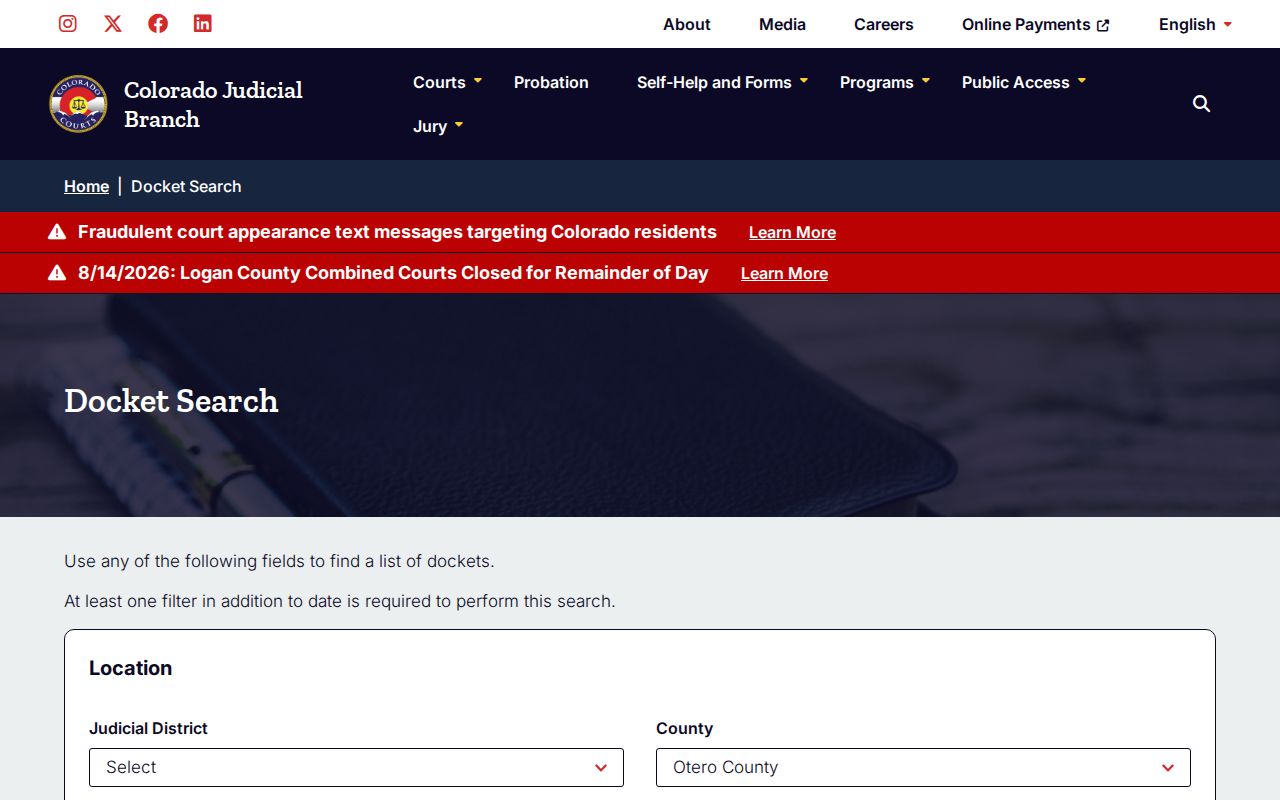
The search screen supports hearing lookup. It does not prove every filing or final disposition in a case.
A name search that returns nothing is not the end. Drop an unneeded division, loosen the date limit, and check the name type. Then try the known case-number pieces. Even a second empty result does not mean no criminal file exists. The case may have no current hearing scheduled. It could be restricted. It could be old enough to need clerk help, or filed in a municipal court. Take the court level, the approximate year, and the exact item you want. Bring them to the Otero clerk instead of trusting the web response as the last word.
Criminal Dockets: What They Show
What an Otero County criminal court docket result shows is a scheduled event, no more. The clerk-side register can hold far more. Read the event card first, then separate its limited fields from the charges, pleas, orders, and disposition kept in the court file itself. A case number such as 2026 + class + sequence stitches together a four-digit year, a Colorado case-class code, and a sequence. Type it as the record shows it. Invented punctuation or leading zeros will break the search.
| Case number | Year, case class, and sequence used to link the setting to the file. |
|---|---|
| Setting | Date, start time, duration, hearing type, appearance type, and courtroom. |
| Charge data | Alleged offense, statute, and class may appear in the fuller clerk record. |
| Plea and orders | Plea posture, motions, bond rulings, and signed orders belong to the official file. |
| Disposition | Dismissal, finding, sentence, costs, or appeal activity must be read in sequence. |
A blank spot on the calendar does not prove the field is empty. Ask the Otero County clerk for the cited paper or register entry to see the exact terms.
Otero County Criminal Docket Outcomes
A charge on an Otero County criminal court docket is only an allegation. It is not a conviction. Outcomes arrive through later docket entries and signed orders. In the same way, a scheduled plea or sentencing date does not prove the event happened as planned. Check the newest entry, and get the order itself when exact terms matter.
- Advisement
- A hearing that informs a person of allegations and rights.
- Arraignment
- A proceeding that addresses the charge and plea posture.
- Reset
- A scheduling move to a later date, not an outcome.
- Disposition
- The status or result that resolves a charge or case.
- Dismissed
- An ended charge or case, subject to the order's terms, but not automatically sealed.
Criminal Case Stages on the Docket
The Otero County criminal court docket puts events in order. Each stage tells you something. A complaint, information, or indictment opens the file. Advisement and arraignment cover rights and plea posture. Bond entries set release terms or change them. Status conferences, pretrial events, and motion hearings prepare the case for resolution. A plea or trial answers the guilt question. Disposition and sentencing entries record the result. A notice of appeal can then move the fight to a separate Colorado appellate docket.
Docket flow: Charge filed › Advisement or arraignment › Pretrial and motions › Plea or trial › Disposition › Sentencing or appeal.
Always read a stage against its date. An old pretrial setting can linger in the history after a continuance. The newest future event and the latest signed order control the case, not a stale calendar line.
Otero County Criminal Docket Treatment
The 16th Judicial District launched Integrated Treatment Court in 2009. Official evaluation material names its Otero component the Otero County Adult Drug Court. Eligible high-risk defendants get judicially monitored treatment and rehabilitation there. The program works through the underlying criminal case. It does not build a separate public accusation database.
Search the same Otero County criminal court docket case number. Read review settings in context. A treatment-court review is a monitored event, not a new charge. Program status, eligibility, and private treatment facts cannot be inferred from the public calendar. The 16th Judicial District summary offers official program context.
Otero County Criminal Docket Courts
Which court holds the charge decides where you look. Felonies go to Otero District Court. Misdemeanors and county traffic cases usually sit in Otero County Court. Both share Otero Combined Court and one clerk in Room 207. Municipal ordinance and city traffic matters stay with the municipal court that issued them. That court's own clerk keeps them. Get this split right first. Any Otero County criminal court docket search goes far more smoothly.
| Court | Typical criminal matter | Custodian |
|---|---|---|
| District Court, A/B | Felonies and related major proceedings | Otero Combined Court clerk |
| County Court, Division 1 | Misdemeanors and county traffic | Otero Combined Court clerk |
| Municipal court | City ordinances and municipal tickets | Issuing city's court clerk |
Appeals move the case to a different docket. A notice of appeal shows up in the trial register, but the Colorado Court of Appeals then opens its own. Track the receiving case number. The trial docket will not carry the full appeal.
Otero County Criminal Docket Orders
Calendars leave a lot out. Bond terms, plea agreement text, and sentencing orders may not appear on the public schedule. So begin with the case number. Pinpoint the document by title and date. The Otero Combined Court clerk can then arrange inspection, a plain copy, a register of actions, or a certified copy. The Otero trial-court page links the local record-search route.
Copies carry set fees. A clerk name search is listed at $5. Paper or electronic copies run $0.25 per page. Certified or exemplified copies cost $20 per document plus the copy charge. The statewide request form says ordinary responses are expected within three business days absent unusual conditions. Off-site retrieval is billed at actual cost. Delivery options include mail, approved email, pickup, and in-person inspection, depending on the clerk and the record. Confirm current charges before you order anything.
Note: Request a certified disposition only when an authenticated court record is required. A calendar printout is not a certified result.
Access Rules for Criminal Dockets
Access has limits. Public Otero County criminal court dockets operate under Chief Justice Directive 05-01 and Public Access to Information and Records Rule 1. Juvenile matters, sealed files, protected addresses, identifiers, and other confidential material may be withheld or redacted. A blank result is not always secrecy, though. It can mean no current hearing, wrong search filters, or an older file sitting off-site.
Public does not mean fully online. The Judicial Branch docket is an informational hearing display. The Clerk of Court, Otero Combined Court, remains custodian of the official criminal file.
Dismissal alone does not seal a charge. Colorado runs separate sealing procedures, with forms available through the Judicial Branch sealing resource. One docket label tells you little about eligibility or public status, so ask the clerk whether the item is sealed, restricted, off-site, or just missing from the web calendar.
Otero County Criminal Docket Resets
A reset or continuance simply moves a setting on the Otero County criminal court docket. It does not dismiss the charge or decide guilt. Old hearing cards can linger in view, so compare dates and hearing types and find the newest future setting. When a schedule clashes with a notice or order, call 719-384-4951 and consult counsel where appropriate.
Bond forfeiture is not a conviction either. Missing a setting can trigger added proceedings, but the real answer lives in the case register and its orders. For the full name-or-number workflow, the Otero County docket search walks through it step by step.
Hearing day close? Save the case number and call the assigned court. A timely clerk check beats any old printout.